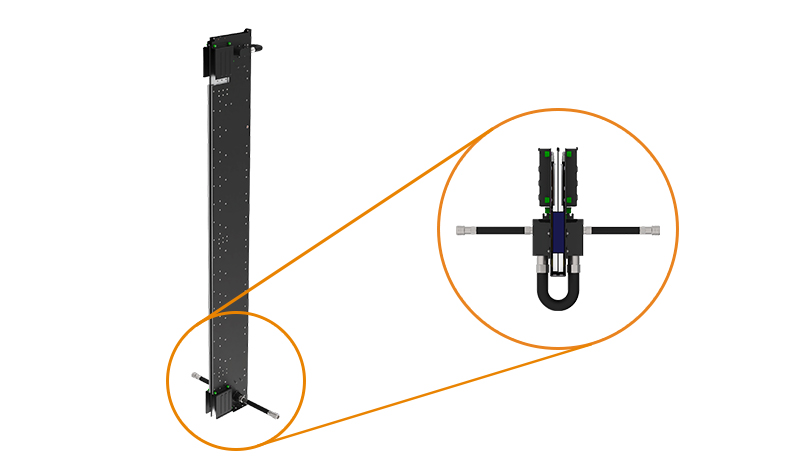
Liquid Cooled Busbar Assembly Supporting Up To 750kW Data Center Racks
Candidate for:EE Awards - Best Power Solution Platform
Liquid Cooled Busbars combine metal conductors with sealed fluid channels that carry a glycol mixture coolant. As electrical current flows through the conductor, resistive losses generate heat (I²R losses). Instead of allowing this heat to accumulate or relying entirely on ambient air cooling, the integrated liquid channels absorb and transport heat away from the busbar with significantly higher thermal efficiency.The cooling system operates in a closed-loop configuration, connected to facility-level cooling infrastructure such as cooling distribution units (CDUs) or central chilled water systems. In high-density deployments up to 750kW, liquid cooling enables tighter conductor spacing and higher current capacity, reducing the physical footprint compared to conventional busbars.Key technical advantages include:
• Higher current density: Liquid cooling allows busbars to carry more current per cross-sectional area.
• Improved energy efficiency: Reduced thermal losses and lower cooling overhead.
• Compact design: Smaller power distribution systems support denser rack layouts.
• Enhanced reliability: Stable operating temperatures reduce thermal stress and material degradation.
• Scalability: Modular designs support incremental expansion in hyperscaler environments.
Liquid Cooled Busbars are an emerging power distribution technology designed to meet the rapidly increasing energy density and thermal management requirements of modern data centers, particularly those supporting high-performance computing (HPC) and AI workloads. Traditional air-cooled busbars are limited in their ability to efficiently dissipate heat at extremely high current loads, which can result in thermal losses, reduced efficiency, and increased infrastructure complexity. Liquid-cooled busbars address these challenges by integrating conductive electrical pathways with embedded cooling channels that circulate liquid coolant directly alongside current-carrying conductors.Liquid cooled busbars enable higher data center sustainability and increase overall rack-level power efficiency while reducing the need to power intensive air-cooling systems. They allow data centers to operate at high power levels with increased current capacity and provide a path to lower total energy usage.
Malicious vote manipulation is expressly forbidden in this voting event. The organizers reserve the right to evaluate the fairness and accuracy of the voting results. AspenCore retains the authority to interpret the rules of this event.