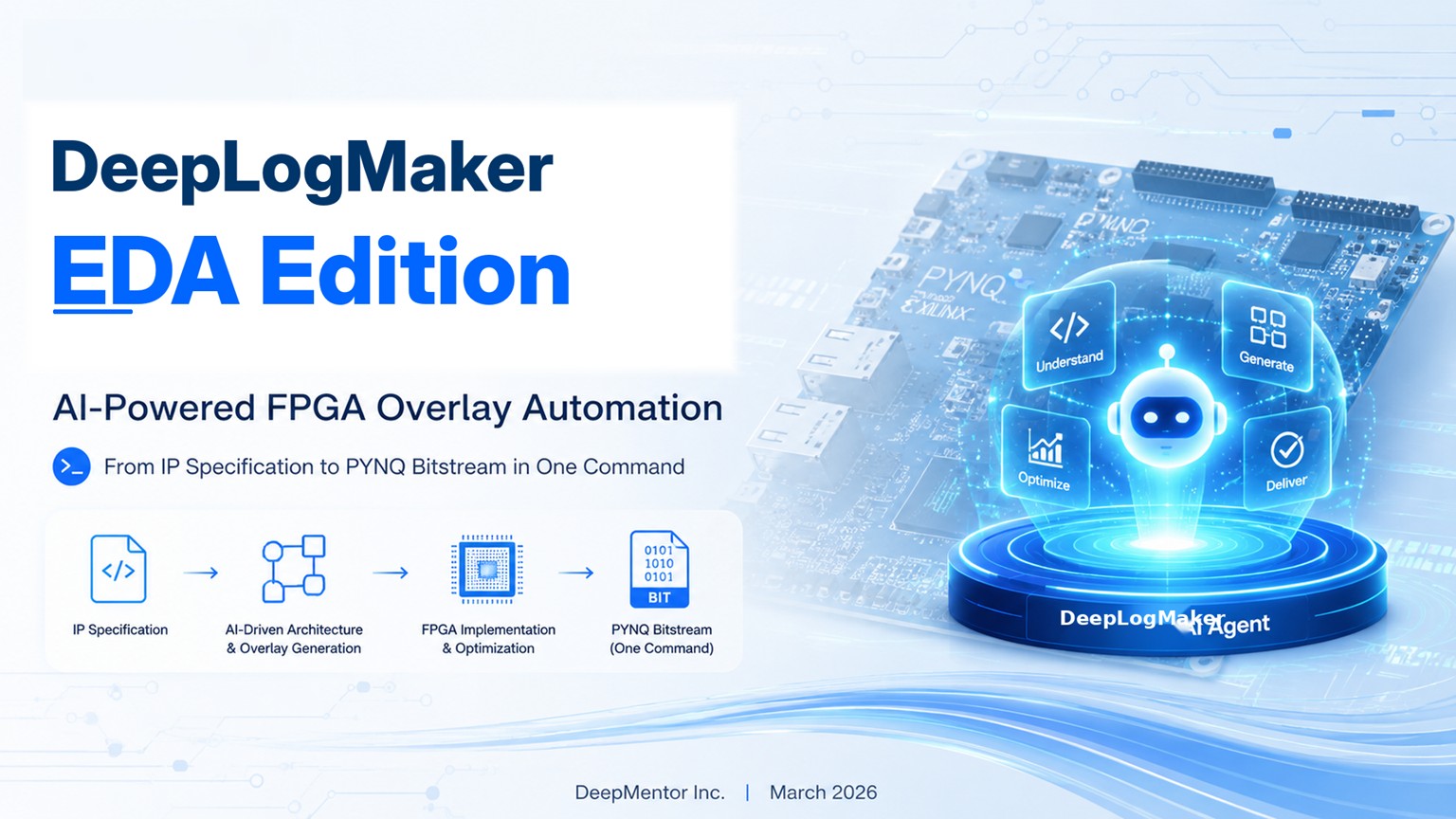
DeepLogMaker turns AI-assisted chip design from a research idea into a working, hardware-verified tool. At its core is a dual-LLM agent framework: one model plans how an AI workload's computation graph should map onto FPGA fabric, while a second model generates the corresponding synthesizable RTL and iteratively self-verifies it against functional and timing checks, closing the design loop with minimal human intervention. This is powered by Algorithm Hardening, a patented technology protected by an issued US patent and a broader 12-patent portfolio, which converts AI computation graphs directly into RTL rather than routing through generic HLS abstractions. The same engine maps efficiently onto both traditional FPGA fabric and embedded eFPGA IP blocks, making it practical for teams prototyping custom edge-AI accelerators before committing to silicon. This isn't a lab demo: a peer-reviewed paper documents a custom RISC-V NPU instruction extension generated through this exact dual-LLM workflow, delivering an 11.6x INT8 GEMM speedup on real hardware. What normally takes weeks of manual RTL coding and verification, DeepLogMaker compresses into days — opening up custom FPGA-based AI acceleration to teams without a dedicated RTL engineering bench. Voting for DeepLogMaker means backing a technology that's already proven, already patented, and already reshaping how edge AI chips move from algorithm to accelerator.
Malicious vote manipulation is expressly forbidden in this voting event. The organizers reserve the right to evaluate the fairness and accuracy of the voting results. AspenCore retains the authority to interpret the rules of this event.